

UAVs are: types of drones, classification and names from practice
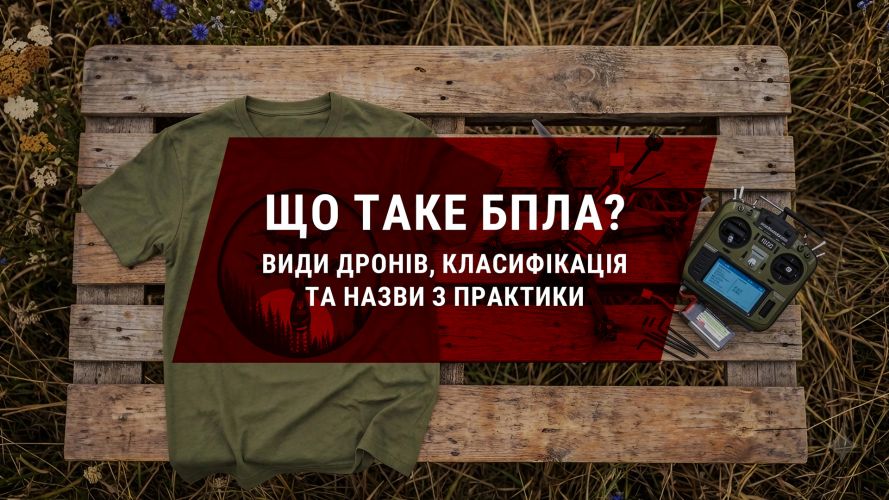
The realities of life sometimes force us to learn about things we would rather not know about. You can read about drones in your apartment building chat, a messenger channel, or on Facebook. For military personnel, the situation is somewhat easier, as there is always someone in the unit’s chat who can tell a quadcopter from a fixed-wing aircraft and explain the characteristics of a particular FPV drone. Similar situations arise in PROF1Group® retail stores. Someone may choose a T-shirt with a drone print, while the person next to them asks how a reconnaissance drone differs from a strike drone.
UAV, or Unmanned Aerial Vehicle – is an aircraft without a pilot on board that is controlled by an operator using a remote control or software. In everyday conversation, people more often simply say “drone,” but this is not an entirely accurate definition of the aircraft. Below, I will briefly explain how drones are classified by shape, weight, and designation, so that next time it will be easier for you to understand the different types.
UAVs: Definition and Why They Are Classified into Different Types
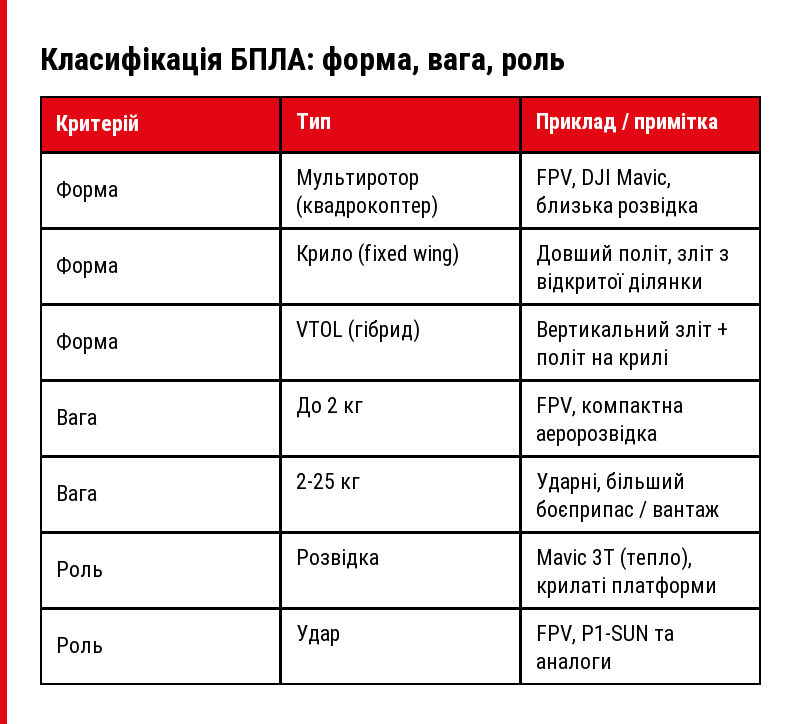
To briefly cover the essentials – a UAV is any aircraft that performs a task without a person in the cockpit. They come in different shapes and designs and may contain various types of electronics inside. For example, a camera, compass, and possibly a payload or warhead. The single word “drone” does not describe all these nuances, nor does it indicate what role the aircraft performs. Specialists divide the characteristics into three subgroups: design (rotors or fixed wing), weight (what it can actually carry), and purpose (reconnaissance or strike).
Classification by Shape: Rotors, Fixed Wing, Hybrid
Multirotor aircraft (quadcopters, hexacopters) are the type most commonly encountered in civilian life. They have been used for panoramic photography, building inspections, and events. Today, combat FPV drones either deliver certain “gifts” to neighbors or perform battlefield aerial reconnaissance. They can take off vertically, hover in one place, and maneuver in confined spaces. Their obvious disadvantage is flight time, which is limited by the battery capacity; strong winds also cause the battery to drain faster.
Fixed-wing UAVs (aircraft-type) have an advantage in endurance because they are powered by combustion engines, although there are also versions with electric motors, such as Leleka-100. They require an open area for takeoff as well as landing, but they can remain in the surveillance area for longer periods.
VTOL (vertical takeoff and landing aircraft) combines both approaches. They are more difficult to operate and require longer crew training. At the same time, they offer greater mobility during takeoff and higher travel speeds.
Classification by Weight and Payload
There are microdrones weighing up to 250 g that are used for indoor reconnaissance. They are small, quiet, but also fragile. If a dog happens to encounter one and decides to play with it, the aircraft can probably be written off. The category of up to 2 kg includes compact FPV drones such as Mavics. They are often used for aerial photography and monitoring roads or positions. Up to 25 kg, we are already getting closer to strike UAVs, as they can carry a larger payload while maintaining a respectable speed. For example, Bulava weighs 11 kg and can carry a warhead of up to 3.5 kg, which already creates certain difficulties with preparation and the launch itself.
In practice, weight affects not only the complexity of the launch but also the time required to deploy the system and prepare the crew. Carrying a couple of cases and setting up a mast is obviously more difficult, which proportionally affects the time required.
Names You Hear on the Front Lines Today
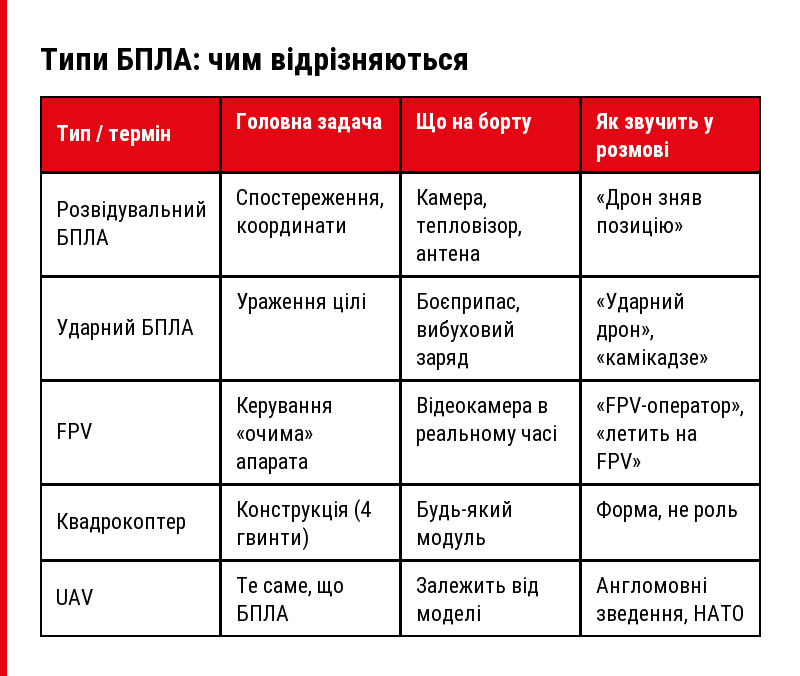
For reconnaissance tasks, the DJI Mavic series is often chosen. The Mavic 3 provides high-quality imagery during the day, while the Mavic 3T additionally features a thermal imaging channel for nighttime operations. This is not the only drone used for aerial reconnaissance, but in everyday conversation, “Mavic” usually refers to a lightweight and agile drone for surveying the terrain.
FPV is a separate category of equipment in everyday military unit operations. It is a small aircraft controlled by an operator via a video link and often used in a strike role. There are many models in this category, and there is not always enough time even to keep up with the paperwork for each aircraft. Therefore, the term FPV is more often used to describe the type of control link, rather than saying something like “a large Mavic with a wing.”
Ukrainian strike and reconnaissance platforms also have their own names and sometimes unique names used within particular groups of people. One example is P1-SUN, a domestic aircraft that may be mentioned in discussions of strike missions. In reports and meetings, the specific model name is usually used rather than the abstract term “drone.”
Reconnaissance, Strike and FPV: How Not to Confuse Them
In fact, it is quite simple:
- reconnaissance – searches for targets, scans the terrain, and transmits coordinates;
- strike – carries a warhead and has one ultimate task: delivering certain “gifts”;
- FPV – describes the method of control and real-time image transmission.
A civilian quadcopter should not be directly compared with a military UAV. They have different levels of resistance to electronic warfare, different protection of the data transmission link, and different communication ranges with the aircraft.
In Practice: What I Hear from Operators and Customers
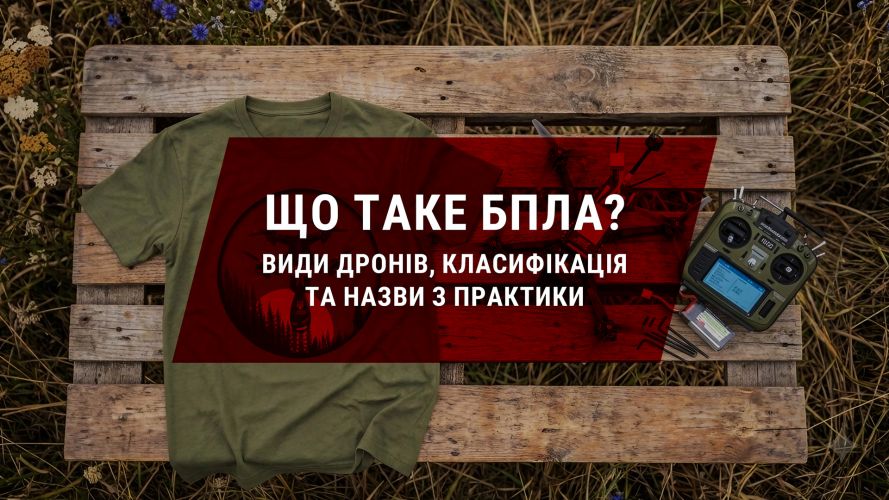
I have been working in the military equipment industry for 25 years. When customers choose a P1G® T-shirt with a "Drone" graphic at PROF1Group®, they sometimes ask what exactly is depicted on it and what type of aircraft it represents. But a graphic is an artistic adaptation, not an aircraft identification document. A T-shirt with such a print is simply themed clothing or a gift. In general, we do not sell controllers or components, but I am always happy to explain the differences between the roles of various drones. After that, it is easier for customers to choose clothing or a gift without worrying that they do not know “what FPV is.”
UAV operators rarely sit at a single location with a backpack. They often have to walk knee-deep through wet grass and mud to set up an antenna, prepare for a launch, or retrieve an aircraft after it lands in a swamp. In such conditions, footwear stops being a minor detail and becomes an important part of the equipment.
For summer terrain and frequent movement between launch points, I recommend looking at LOWA® Innox PRO GTX® LO TF or Zephyr GTX® MID. They feature a Gore-Tex® membrane, good grip on wet ground, and lower weight compared with classic combat boots.
Common Mistakes When Talking About UAVs
- Reducing all models to the term FPV, even though it refers not to the aircraft itself but to the video control link.
- Knowing the terminology does not make you an aircraft pilot. General awareness is not a substitute for specialized training.
- The aircraft's weight should not be ignored, because it usually has to be carried several more kilometers from the vehicle.
- A military aircraft should not be compared directly with civilian models. Equipment designed for military use is generally more reliable and durable.
Do not assume that understanding the terminology can replace operator training. Knowing what a UAV is can be useful. It does not make you a pilot without proper training. Terminology is intended for orientation, not for assigning yourself a role.
In Brief: UAVs and Your Choice
A UAV is an unmanned aerial vehicle. In everyday conversation, “drone” often means the same thing, but for accurate classification, three aspects are useful:
- aircraft weight
- shape (rotors, fixed wing, VTOL)
- purpose (reconnaissance, strike, FPV link)
Three questions to ask before arguing about “which drone is better.” The answers will help set the right priorities without unnecessary noise.
- What shape is required for your launch site?
- What payload or sensor is carried onboard?
- Is it for reconnaissance, strike operations, or civilian photography?
Classification by design and weight eliminates most of the confusion found in the news. Names such as Mavic, FPV platforms, and P1-SUN refer to specific classes of tasks in conversation rather than interchangeable "drones." If you are looking for themed clothing, the range includes P1G® "Drone" graphic T-shirts. If you are preparing a gift for an operator or equipping yourself for field use, take a look at LOWA® footwear for wet summer terrain.
I would also add that choosing the right size and model is more convenient in a store than trying to guess from a phone screen.
Author: Kostiantyn Lesnik