



How to wash a membrane jacket?

The membrane jacket is an indispensable item of clothing. It acts as a technological shield, protecting against rain, wind, and cold without creating a greenhouse effect underneath. However, like any other garment, a membrane jacket requires proper care. If you follow the care recommendations, it will serve its owner well and for a long time.
Content
- Why does a membrane jacket require special care?
- What happens if you wash a membrane jacket incorrectly?/a>
- Preparing to wash the membrane. Little tricks that solve everything
- Washing the membrane: machine vs hand wash – which is better?
- Drying a membrane jacket. How not to ruin everything at the finish line?
- DWR coating. How to restore the jacket's ability to repel water?
- A few conclusions
Why does a membrane jacket require special care?
The membrane jacket is made from expanded polytetrafluoroethylene (ePTFE), which has a microporous structure. The membrane layer contains billions of tiny pores that are 20,000 times smaller than a drop of water and 700 times larger than a molecule of vapor. Due to its technological properties and high efficiency, tactical jacket manufacturers use the membrane to create equipment that can withstand any weather conditions.
However, when using a product with a membrane or caring for it incorrectly, the pores become clogged and it loses its properties. Therefore, a membrane jacket requires proper and careful care.
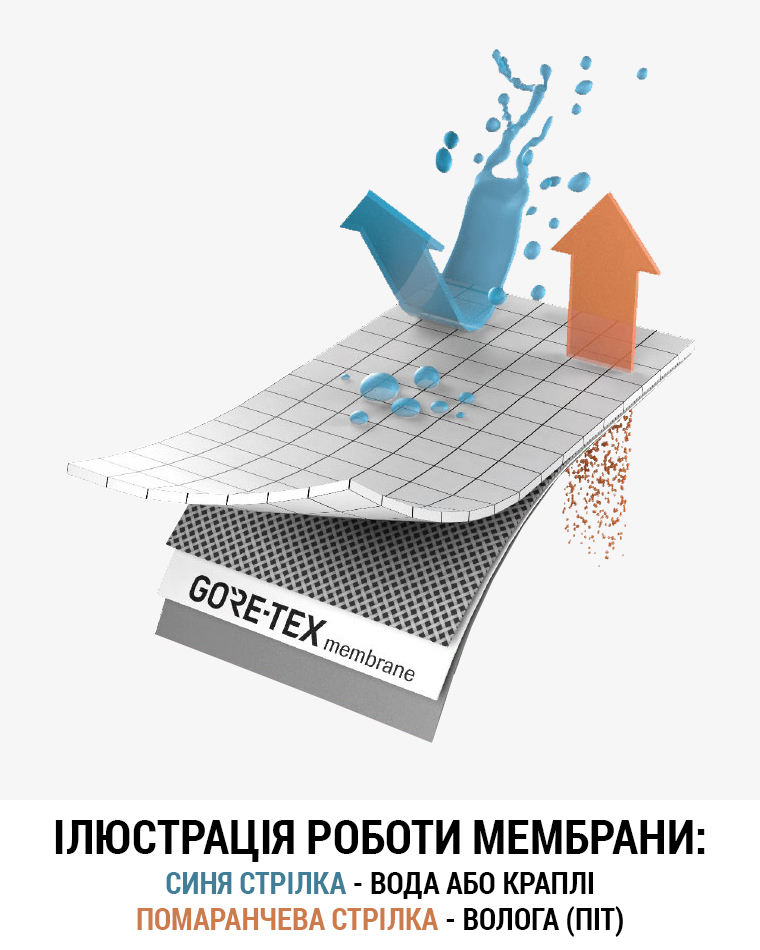
There are several types of membrane fabrics, and using the example of the most commonly used three-layer membrane (referred to as 3L), we will take a closer look at what layers it consists of:
- Outer layer. Made of nylon or polyester, it protects the membrane itself from damage.
- Membrane. It acts as a barrier that protects against precipitation and wind and wicks heat and moisture away from the body.
- Inner layer. Protects the membrane from damage from the inside, can be made of mesh, micro fleece, etc.
In the case of a three-layer membrane, all layers are bonded together by lamination. Improper washing or other care may result in loss of its properties and delamination of the layers.
The outer layer is usually coated with a special impregnation that creates an additional barrier and causes water to roll off in droplets without penetrating deeper into the fabric. However, it may need to be renewed over time after prolonged use or after contact with aggressive chemicals in the form of granular washing powders or bleaches.
What happens if you wash a membrane jacket incorrectly?
The answer is actually quite simple: if a membrane jacket is not washed correctly, it will cease to function properly. Different types of exposure can have different consequences that will negatively affect the jacket. Below, we will discuss the most common ones.
Washing with detergents that are not suitable for membranes, such as granular detergent, not only fails to clean the membrane, but actually clogs it. After such washing, the jacket stops wicking away moisture and creates a sauna effect underneath. Even in cold weather, you can sweat profusely in such a jacket.
High temperatures during washing or drying (above 40° C) can cause the layers to stick together or, conversely, form bubbles between the layers. After this, the membrane jacket will start to let water in and let wind through.
Spinning at high speeds causes creases or even cracks in old garments. When the integrity of the fabric is compromised, a membrane jacket not only loses its properties but also ceases to look neat.
The effect of fabric softener or chlorine in particular irreparably destroys the structure of the membrane. After such washing, irreversible consequences can be expected in the form of excessive moisture absorption, delamination of the material, and rapid wear of the product.
The effectiveness of DWR coating decreases when wearing a membrane jacket with a backpack, frequent washing, or using the wrong detergents. To prevent the membrane from reaching the limits of its capabilities, it is necessary to restore the DWR coating.
Preparing to wash the membrane. Little tricks that solve everything
As in any endeavor, preparation is the key to success. Without proper preparation for washing, even the most effective detergent will not be able to do its job properly or prevent damage to the membrane. Below, we provide tips on how to properly prepare your jacket for washing so that it looks like new after the process is complete.
Remove all unnecessary
First, check your pockets and remove all items from them. Sometimes you can forget small items or small souvenirs found during your trip in your outer and inner pockets. There should be no napkins, coins, stones, or chewing gum left in the pockets. Not only can these items damage the fabric, but they can also get stuck in the washing machine.
Secondly, all zippers, hook-and-loop fasteners, and buttons must be fastened. Open metal zipper teeth scratch the membrane, and hook-and-loop fasteners collect lint and threads.
Finally, if the jacket has decorative elements, they must be removed. The hood or cuffs may have fur elements or patches. Remove them to preserve their original appearance and ensure that the washing is as effective as possible.
The fight against spots
The membrane is a high-tech material, but it is vulnerable to aggressive chemicals. On the Internet, you can find recommendations for removing stains using alcohol, vinegar, or citric acid. You can use them only at your own risk, because such agents irreversibly damage the membrane.
It is common for membrane jackets to have grease or oil stains. Fresh stains can be gently blotted with a dry napkin and then gently wiped with a damp, alcohol-free napkin. If you have access to dishwashing liquid, you can take a small drop and gently apply it to the stained area. After that, wait a couple of minutes and rinse off the detergent with cool water, gently wiping it off the fabric with your finger.
If these steps do not help, you can apply a membrane cleaning agent locally, rinse it off, and dry the jacket. This is the safest and most effective way to clean any dirt from membrane fabric.
Choosing a detergent
An important point in caring for a membrane jacket is to choose the right product that will not harm it and will clean it effectively.
It is forbidden to use:
- bleaches;
- fabric softeners;
- conditioners;
- stain removers;
- loose powder detergents (even for children).
Allowed to use:
- Specialized gels for membrane fabrics. They do not contain surfactants, fragrances, and enzymes. Also, such gels do not clog the pores of the membrane. For example, Nikwax® Tech Wash®, Grangers® Performance Wash, etc.
- For local stains, there is a special foam. It is not only applied pointwise, but also does not require rinsing. For example, Salton® Sport Foam.
Little things that you can accidentally forget
First, check the washing instructions on the label. If possible, take a photo before the first wash and save it in case the label wears off. If this happens, find the information on the manufacturer's website or contact the store where you purchased the item.
Check the seams for leaks. If possible, check whether the thermal tape has come unstuck from the seams. If this is not possible, simply pour water onto the seam and then press it with your finger. If water has seeped through the seam, and you are sure that the problem is with the thermal tape, you can seal the affected area with a special product, such as Gear Aid® Seam Grip.
Put the jacket in a mesh bag before washing. This simple step will protect the fabric from rubbing against the drum and extend its life.
What should never be done
Wash at temperatures above 40° C. This will deform the membrane, and it will no longer retain its properties.
Use brushes with stiff bristles. This can not only cause mechanical damage to the product, but also “wear away” the DWR coating.
Do not speed up drying with a hair dryer. Hot air that is not evenly distributed over the fabric leads to local clogging of the pores, which is an irreversible process.
Preparing a membrane jacket for washing is like preparing an operating room for a surgeon. Every little detail is important: the wrong detergent or a forgotten coin in the pocket can ruin expensive fabric. Spend 15 minutes preparing your jacket, and it will reward you with years of flawless service.
Washing the membrane: machine vs hand wash – which is better?
The choice between machine and hand washing a membrane jacket depends not only on your preference, but also on the condition of the fabric and the type of stains. Let's take a closer look at both methods so that you can make an informed decision.
Machine washing: when speed and convenience do not compromise quality
We suggest machine washing if:
- No time or desire to wash by hand.
- Jacket without serious stains, with uniform soiling.
- The washing machine supports delicate modes (“Membrane”, ‘Sport’ or “Hand wash”).

Step-by-step instructions:
- The jacket is packed in a mesh bag to protect the fabric from rubbing against the drum and zipper.
- The garment is loaded into an empty machine, as washing with other clothes increases the risk of damage from buttons or zippers.
- Set the temperature to 30-40° C (depending on the care instructions on the label).
- The spin cycle should be turned off completely or set to a minimum of 400-600 rpm.
- If the machine has this function, turn on the double rinse cycle.
- Add gel for washing membrane fabrics according to the manufacturer's recommendations. For example, Nikwax® Tech Wash® recommends 3 capfuls for 1-2 items of clothing.
- After washing, it is recommended to remove the jacket immediately, as leaving it in the drum for a long time will cause creases to form on the fabric.
The advantages of machine washing membranes are that it is not only quick and convenient, but also that the machine washes the detergent out of the deep layers of the fabric better.
The disadvantages include the risk of damage to zippers or decorative elements. Also, this method is not suitable for jackets with peeling membranes or damaged seams.
Handwashing: control over every movement
We recommend to choosing handwashing if:
- You don't trust washing machines.
- The jacket has local stains (dirt on the cuffs, traces of a campfire).
- The membrane has already started to peel (handwashing is gentler).
Step-by-step instructions:
- Fill a container with water at a temperature not exceeding 30° C, such as a bathtub or basin.
- Add the membrane gel and stir it into the water. For Nikwax® Tech Wash®, use 3 capfuls per 1-2 items of clothing.
- Immerse the jacket in water and leave it for 10-15 minutes to allow the dirt to soften.
- Use a soft sponge or a toothbrush with silicone bristles to treat the jacket during washing.
- When treating stains, move from the edge to the center so as not to increase the area of contamination.
- Rinse the jacket 4-5 times and change the water until it becomes completely clear.
- Drain the water without wringing out the jacket. Press the fabric against the sides of the basin with your palms to remove excess moisture.
The advantages of handwashing the membrane are that you can target specific stains. There is also much less risk of damaging the jacket with zippers.
The main disadvantages are the time and effort required and the large amount of water used for rinsing.
Which is better? Comparison table
|
Criterion |
Machine wash |
Handwash |
|
Time |
1-1.5 hours |
1-2 hours |
|
Efficiency |
Even cleaning |
Better for localized stains |
|
Security |
Risk of zipper damage |
Minimum risks |
|
Water/energy |
More economical (if washing 1 item) |
Higher water consumption |
|
Suitable for |
Fresh dirt, city jackets |
Better for heavily soiled gear |
Several situations where the choice is obvious:
- Jacket with down insulation – machine wash on the “Down” cycle.
- It is best to do urgent laundry before traveling, using a washing machine.
- After a mountain hike, it is better to wash by hand (dirt gets stuck in the seams and cuffs).
- Children's jacket with prints – machine wash in a bag (prints may crack when washed by hand).
Both machine and handwashing are acceptable if you follow the rules. Choose a washing machine for regular care and new stains, and your hands for “rescuing” your favorite jacket after adventures. The main thing is no experiments with granular powder and hot water!
Drying a membrane jacket. How not to ruin everything at the finish line?
Drying a membrane jacket is a stage where even a small mistake can ruin all your efforts. The membrane, like a living organism, is sensitive to temperature, mechanical stress, and ultraviolet light. Below, we will explain how to dry a jacket so that it retains its shape and functionality and does not turn into a boiled rag.
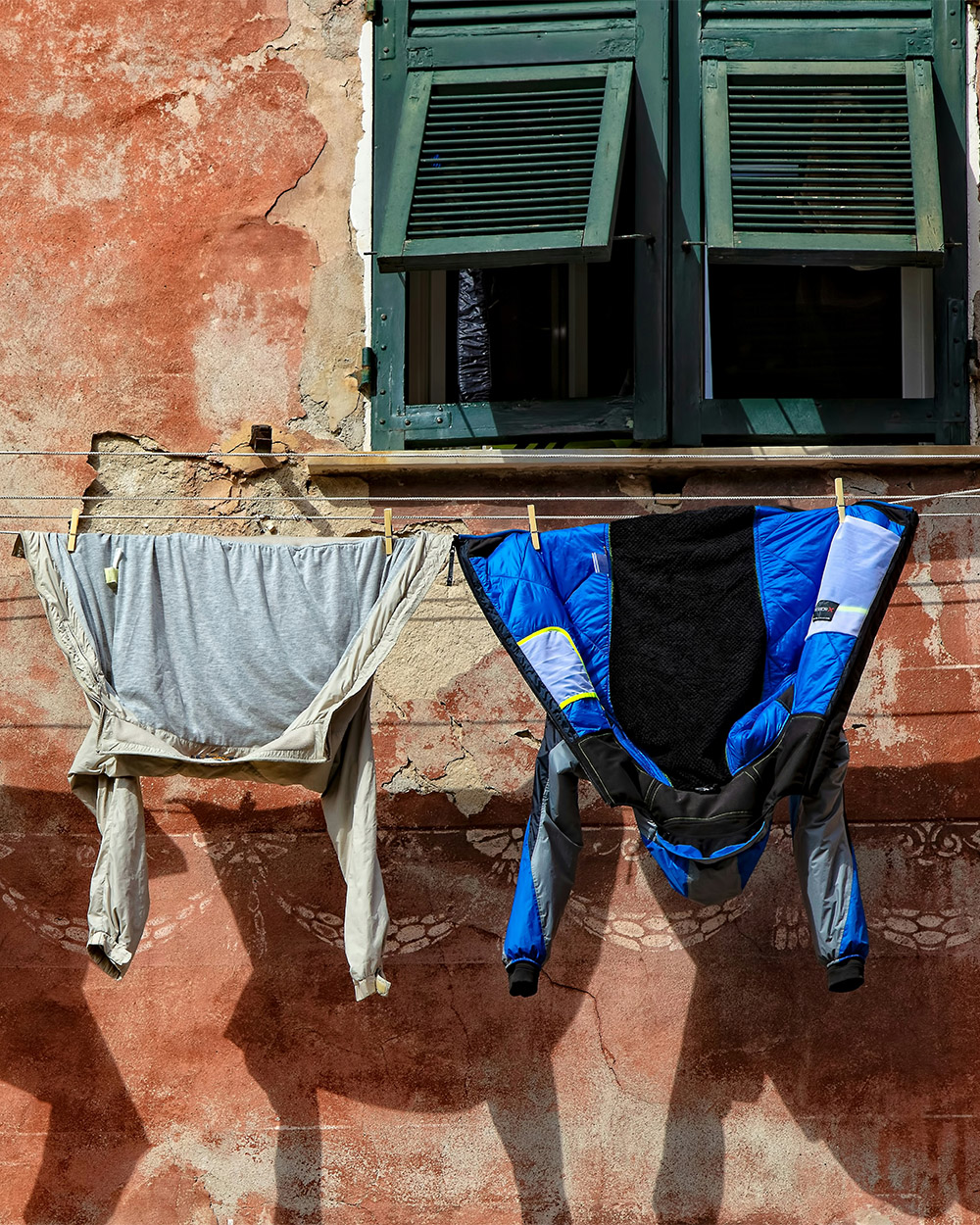
What to do in the first 10 minutes after washing:
- Do not hang the jacket on hangers immediately.
- Spread a terry towel on the floor.
- Place the jacket face down.
- Roll up the towel, pressing lightly to absorb the water.
- Repeat with a dry towel if necessary.
Where is the best place to dry membrane clothing?
|
Place |
Pluses |
Minuses |
|
On clothes hanger in the room |
Even drying, shape retention |
Long (12-24 hours) |
|
On the balcony in the shade |
Natural ventilation |
Risk of dust, insects, temperature changes |
|
On the clothes dryer |
You can work out all the details |
Needs a lot of space |
|
By the open window |
Rapid moisture evaporation |
Draft or strong temperature changes can deform the fabric |
How to dry is prohibited:
- On batteries or heaters, as high temperatures can damage the fabric layers.
- In direct sunlight, as ultraviolet rays destroy the DWR coating and accelerate color fading.
- Machine (tumble) drying, unless permitted by the manufacturer, because even a delicate cycle can damage the seams.
How to speed up drying without harm
Step 1. Turn the jacket inside out – this will speed up the evaporation of moisture from the inner layer.
Step 2. Spread out all pockets, cuffs, and hoods. Place fabric rollers under them to avoid creases.
Step 3. Point a fan at the jacket (set to “Cold Air” mode). Keep it at least 1 meter away.
Step 4. Turn the jacket over every 2-3 hours.
Important! If the jacket takes more than a day to dry, this is normal. The membrane does not absorb water, so moisture evaporates only from the surface.
Drying in extreme conditions
What to do when your jacket gets wet during a hike and there is no way to dry it indoors:
Step 1. Shake off any water droplets and blot with a napkin.
Step 2. Put the jacket on—your body will warm the fabric and the moisture will begin to evaporate.
Step 3. If possible, hang it 2-3 meters away from the fire. Do not hang it closer, as the jacket may lose its properties.
Drying quality check
Crease test: run your palm over the fabric. If you feel creases, the jacket has dried unevenly. Sprinkle these areas with water and dry them.
DWR test: drip water onto the fabric. If the drop does not roll off, the impregnation is damaged. Apply Nikwax® TX.Direct® spray and dry again.
Seam check: make sure that the taped seams have not come apart.
Mistakes that turn drying into a disaster
Drying in a rolled-up state. The jacket will either not dry or will dry in a lump, and it will be impossible to straighten it out.
Using scented wipes. They leave greasy marks that block the pores.
Ironing to speed up drying. Even through the fabric, the iron melts the membrane.
Storing in a damp closet. Mold will appear, and the jacket will start to smell.
Life hacks for perfect drying
A few simple tips to help dry your jacket:
- Unzip the ventilation zippers. This will speed up air circulation inside the jacket.
- Put tennis balls wrapped in cloth in the pockets. They will help maintain the shape of the garment during drying.
- Place a container of rice or silica gel next to the jacket. They will help speed up the process if the room is humid.
Proper drying of a membrane jacket requires patience and time. We recommend that you be patient and have free time to do this properly, and the jacket will reward you with reliable service. The main thing to remember is that the functionality of the jacket depends not only on washing, but also on proper drying.
DWR coating. How to restore the jacket's ability to repel water?
DWR (Durable Water Repellent) – is a water-repellent impregnation that acts as an additional “protective shield” for the jacket. It prevents moisture from penetrating inside and helps drops simply roll off the fabric. The appropriate coating is used by leading tactical equipment brands 5.11 Tactical®, P1G®, Sturm Mil-Tec®, whose waterproof jackets you can find in the PROF1Group® catalog.
During use, DWR impregnation tends to wear off in areas of constant contact with equipment, such as the shoulders or cuffs. Below, we will look at the main criteria for DWR wear and how to restore it.

The main sign of DWR wear is when the fabric gets wet and raindrops do not roll off the fabric. Dark wet spots form on the surface of the jacket, and the jacket becomes heavy. In some cases, the inside of the jacket may be dry, but this is temporary. In such cases, it can be accurately stated that it is time to renew the DWR coating.
There are several situations when restoring impregnation will not help, the main ones being:
- Several treatments have been carried out, but the jacket still gets wet.
- The jacket's pores are clogged with dirt or granular powder. Try washing it with a special gel for membrane fabrics.
- Thermal damage to the membrane, for example, from a fire or hot air drying. Unfortunately, in this case, neither the coating nor the membrane itself can be restored.
In all other cases, you should try to reapply the waterproofing treatment so that the jacket works like new again.
Ways to restore DWR
In general, there are two main ways to restore DWR coating:
- thermal activation;
- application of new coating.
The method of thermal activation of DWR impregnation consists in “opening” the fabric pores and then fixing them. To do this, place the jacket in the dryer for 20 minutes on the “Delicate Dry” setting (temperature up to 40° C).
There is also an option to activate using an iron:
- Do not use steam under any circumstances, as it may damage the membrane.
- Cover the jacket with a layer of cotton fabric.
- Set the iron to the lowest temperature (Silk or Synthetics mode).
- Quickly iron the necessary area without applying additional pressure.
The new DWR treatment can be applied either completely or selectively. For complete treatment, you will need Nikwax® TX.Direct® gel or a similar product. After washing the jacket, immediately start a new wash cycle with the treatment added, and only then dry the jacket.
Local impregnation can be done with the same Nikwax® TX.Direct® product, but in spray form. To do this, follow these steps:
- Be sure to wear gloves and lay out the necessary area of the jacket evenly.
- Spray the outer layer of fabric from a distance of 15 cm.
- Wait 2 minutes and then remove excess product with a damp sponge.
- Dry the jacket at room temperature or in a dryer (use the “Delicate Dry” setting at a temperature of up to 40°C).
- If, after using the spray, the drops do not roll off the fabric, it is better to completely soak the product immediately after washing.
The main mistakes that can be made during coating:
- Application to dirty fabric. The impregnation will stick to the dirt, not the fibers.
- Too thick a layer. Excess product will clog the pores of the membrane.
- Drying without activation. The impregnation will not set and will wash off after the first rain.
- Use of wax products, which are generally unsuitable for membranes.
A few conclusions
Proper care of the membrane will help extend its service life. The key to success in this matter is specialized washing and impregnation products, sufficient time, and patience.
No matter how well you take care of your membrane jacket, it will not last forever. After 5-7 years, it will begin to lose its properties, and it will be time to replace it with a new one. During this period, new technological solutions will appear, and membranes will become even better. When choosing a membrane jacket, we recommend paying attention to jackets from the following manufacturers:
These brands are known not only for the high quality of their products, but also for their use of modern technologies and the durability of their goods. Such jackets will protect you from rain and wind while wicking moisture away from your body.